
Nexstar’s message is straightforward: local television needs room to compete.
Fair enough.
The rules governing broadcast ownership were written for another era. Before streaming. Before smartphones. Before Google and Meta took an enormous share of local advertising dollars without having to cover one city council meeting, one school closing, one hurricane or one breaking-news event at 2:30 in the morning.
The old model is gone. Pretending otherwise does not protect local television. It just protects outdated thinking.
So yes, broadcasters need more flexibility. They need access to capital. They need the ability to invest, scale, negotiate and compete against companies that operate nationally—or globally—without carrying the same public-interest obligations local stations still carry every day.
But let’s not get too carried away.
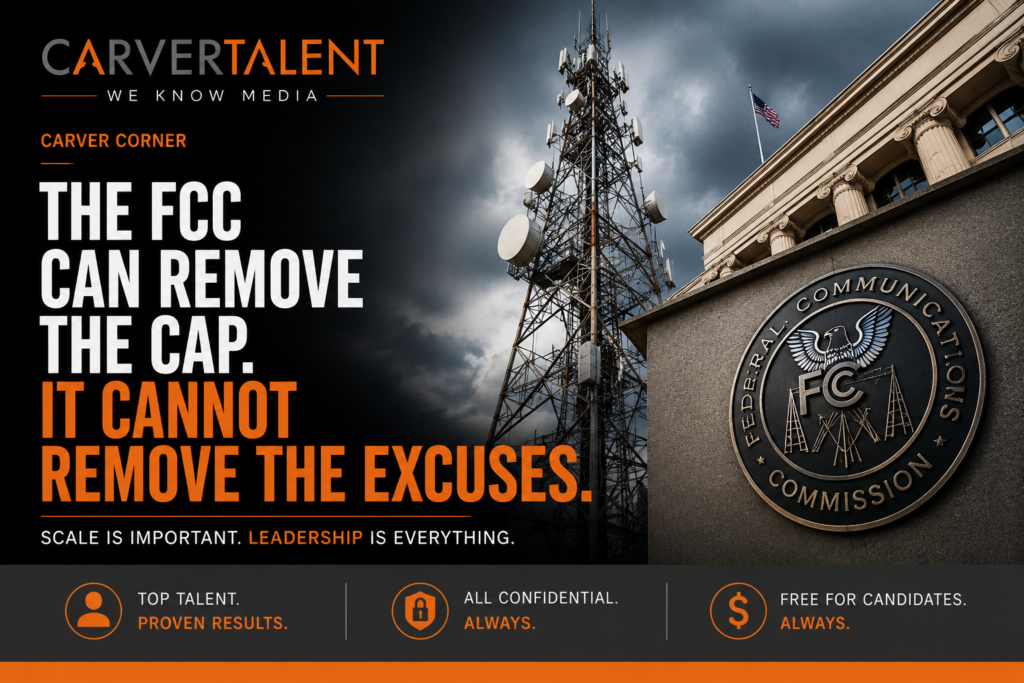
The FCC can remove an ownership cap. It cannot remove bad leadership. It cannot fix slow decision-making. It cannot make a company innovative simply because it owns more markets.
And it certainly cannot give local television a strategy.
That part still has to come from the people running the business.
There is a tendency in broadcasting to treat regulatory relief like a rescue plan. If only the rules were different, we could compete. If only we had more scale, we could invest. If only we could own more stations, the future would look brighter.
Maybe.
But the industry has had opportunities before. It has had political revenue. Retrans growth. Digital products. New networks. New sales platforms. New acronyms every few years that were supposed to change everything.
And yet plenty of station groups still operate like the biggest threat is a lack of permission.
It is not.
The biggest threat is that too many broadcasters are still trying to run a 2026 media business with layers of approval, cautious leadership, outdated compensation models and exhausted people being asked to do the work of three departments.
The ownership cap was not the reason a strong General Manager cannot get a decision made. It was not the reason a Local Sales Manager is buried in reports instead of coaching sellers. It was not the reason talented digital people leave for companies that move faster, pay better and do not make them explain streaming to executives who have been “working on a digital strategy” since 2014.
That is not an FCC issue.
That is a leadership issue.
Nexstar is right to argue that broadcasters need the ability to scale. The scale argument is real. The competition is real. Broadcasters are not just competing with the station across town anymore. They are competing with every streaming platform, social platform, content company, creator, search engine and targeted-advertising machine with access to local businesses.
But scale is only valuable if it creates something better.
More investment in local journalism? Good.
Better technology and stronger digital products? Necessary.
More authority for market leaders to make decisions based on their own communities? Now we are getting somewhere.
But if “greater freedom” just means more centralization, more layers, more corporate mandates and more high-performing employees wondering why they should stay, then this industry is not modernizing. It is simply getting larger while becoming less local.
That is a dangerous trade.
Local television still has an advantage that Netflix, TikTok, YouTube and every other platform cannot easily recreate: trust in a community. Not perfect trust. Not automatic trust. But real, earned relevance when something happens where people live.
That advantage is not protected by an ownership cap.
It is protected by good people in local markets who know the community, understand the advertisers, recognize the audience and have enough authority to act before someone at corporate schedules a meeting about it.
The FCC has opened a door. Fine.
Now broadcasters need to walk through it with more than an acquisition strategy.
They need a talent strategy. A leadership strategy. A localism strategy that exists somewhere other than a Washington talking point.
Because owning more stations may make a company bigger.
It does not automatically make it smarter.
About Carver Talent
Carver Talent specializes in recruiting high-impact leaders across local television, digital media, revenue leadership, news management, and broadcast operations nationwide.
We understand this industry because we live in it every day.
And in a media landscape evolving this quickly, strategic talent decisions matter more than ever.

Ty Carver has over 30+ years of recruiting, HR management, sales, and leadership experience…including the last 15 specific to the broadcast media industry. He is the Founder/CEO of Carver Talent, a local broadcast media management recruiting firm. As the former Head of Recruiting for Raycom Media, he has deep industry relationships. Have a media corporate executive/management or television station management recruiting need? Contact ty@carvertalent.com for more information.