
There is a fundamental mistake I see companies make when they talk about recruiting.
They confuse the applicant pool with the talent market.
They are not the same thing.
A position opens. The company posts it. The job goes on LinkedIn, the corporate career site and maybe a few industry boards. Applications start coming in. Résumés get screened. Interviews get scheduled.
And everyone assumes they are now looking at the available talent.
They aren’t.
They are looking at the people who decided to apply.
That’s an important distinction, particularly in media right now.
Some of the best sales leaders, news managers, engineers, anchors and department heads in this business aren’t actively looking for another job. They aren’t spending their evenings refreshing job boards. They aren’t submitting applications to six companies and waiting for someone from HR to call.
They’re working.
Some are happy. Some are restless. Some are frustrated with their company but haven’t reached the point where they’re ready to leave. Others would consider exactly one kind of opportunity — the right market, the right boss, the right compensation, the right challenge — but they’re not going to go searching for it.
They have to be found.
After more than 30 years in recruiting, I’ve learned that the person most likely to change an organization is often the person least likely to apply for the job.
That’s especially true as you move higher in an organization.
Think about the executive you would most like to recruit from your competitor. The sales leader consistently beating budget. The news manager whose newsroom keeps producing talent. The engineer everyone calls when something breaks. The anchor who has credibility in the market and leadership ability behind the scenes.
How likely is that person to stumble across your job posting Tuesday night and click “Apply”?
Maybe.
I wouldn’t build my recruiting strategy around it.
Yet companies do exactly that.
They post a critical opening and wait. Thirty days pass. Then 60. Sometimes 90.
The same position gets reposted.
The job description gets rewritten.
Maybe the compensation gets adjusted.
And eventually somebody says something I hear all the time:
“There just aren’t any candidates.”
Usually, that’s not true.
There may not be enough applicants.
That’s a very different problem.
The Passive Market Is the Market
One of the biggest changes I’ve seen in recruiting is how selective experienced people have become about making a move.
Changing jobs carries risk. Changing companies carries risk. In television, changing jobs often means changing cities, selling a house, moving a family and betting that the company you’re joining won’t restructure the position six months later.
People understand that.
So the threshold for getting a strong passive candidate to move is much higher than the threshold for getting someone to click an application button.
That’s why passive recruiting isn’t simply sending someone a LinkedIn message that says, “I saw your profile and thought you might be interested.”
You have to know what might make that person listen.
Sometimes it is money.
Often it isn’t.
It might be a larger market. A better leadership situation. More autonomy. A path to becoming a general manager. The chance to rebuild a department. A move closer to family. A company they trust more than the one they’re working for today.
And sometimes the first answer is no.
Good recruiters understand that “no” and “never” aren’t always the same answer.
Relationships matter because careers change. Companies change. Bosses change. Families change. The candidate who wouldn’t take your call two years ago may be very interested in hearing what you have to say today.
That’s why recruiting is not simply a transaction that begins when a requisition opens.
The best recruiting networks are built long before the job exists.
Stop Fishing in the Same Pond
I see another problem frequently, particularly with difficult searches.
A company isn’t satisfied with the candidates it has interviewed, so it keeps going back to essentially the same source looking for different candidates.
Post again.
Refresh the job board.
Wait another week.
Review another batch of applicants.
Eventually you’re fishing in the same pond and wondering why you’re catching the same fish.
Meanwhile, the person you actually need may be sitting at a competitor 300 miles away with no idea your opportunity exists.
Nobody has called them.
That isn’t a candidate shortage. It’s a sourcing problem.
And there is an organizational cost to letting that problem drag on.
A sales department without the right leader doesn’t stop operating while the search continues. A newsroom doesn’t pause because the News Director position has been vacant for three months. Engineering problems don’t wait for the Director of Engineering search to be completed.
Other people absorb the work.
Decisions get delayed.
Good employees get frustrated.
Sometimes they leave too.
“Time kills all deals” is an old recruiting expression because it is true. But time also damages organizations while leaders wait for the perfect candidate to appear.
Recruiting and Processing Applications Are Different Jobs
None of this means companies shouldn’t post openings or consider active candidates. Some extraordinary people actively pursue their next opportunity.
The mistake is believing that posting the job constitutes a recruiting strategy.
It doesn’t.
Processing applicants is largely reactive.
Recruiting is proactive.
Recruiting means identifying someone who isn’t looking and giving that person a reason to listen. It means understanding the competitive landscape, knowing where the talent sits and having enough credibility with people in the industry that they’ll take the call even when they aren’t actively job hunting.
And then you have to move.
Because the best candidates usually have options.
I’ve watched companies spend weeks trying to decide whether they want to conduct one more interview while the candidate they liked accepted another job.
I’ve watched hiring processes become so complicated that everyone involved seemed to forget the original objective was to hire somebody.
I’ve also watched companies move decisively when they met the right person — and win.
There is a lesson in that.
Hiring isn’t about conducting the most thorough process possible. It’s about making a good decision with enough information and enough urgency to secure the person who can make the organization better.
Those aren’t always the same thing.
This Is What We Do
This is also why I built Carver Talent around a different model.
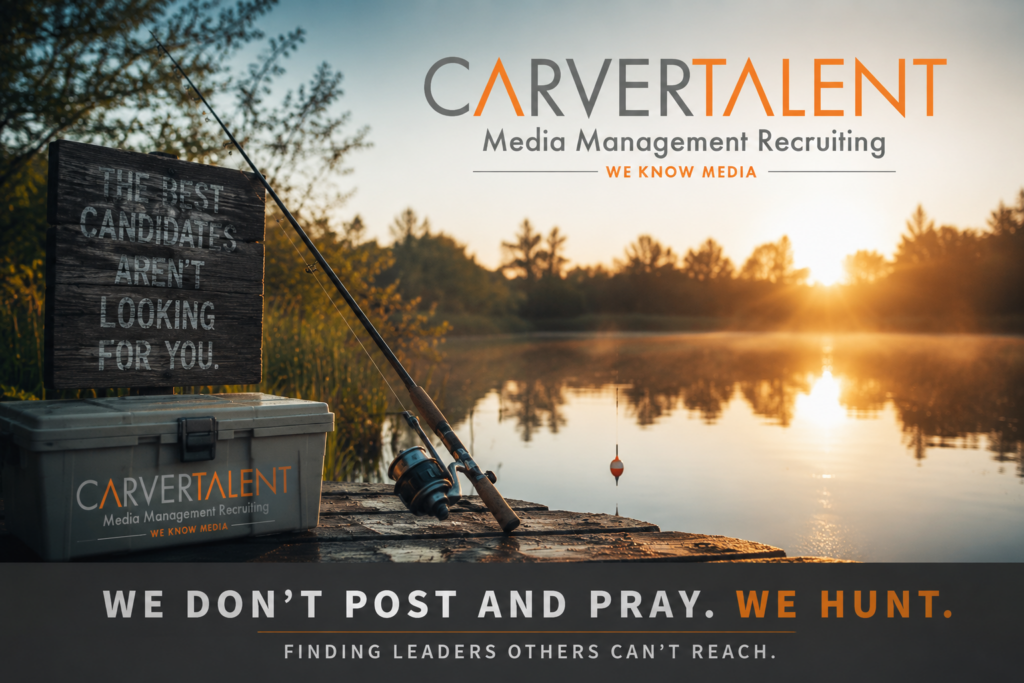
We don’t post and pray.
We hunt.
Our job isn’t to duplicate your internal recruiting process or send you another stack of résumés from people who already applied to your opening. Our job is to go into the media talent market and find the people who probably aren’t going to apply.
The passive candidates.
The people working for your competitors.
The people who might tell us “I’m not looking” in the first 30 seconds of a conversation — and then spend the next 20 minutes asking about the opportunity.
That’s where recruiting gets interesting.
And our model makes it pretty simple for media companies to test whether we’re right.
Compare our best against the best candidates your internal process produces.
There is no fee to let us search. There is no fee to review or interview a Carver Talent candidate. You only pay our recruiting fee if you decide to hire one of the media management candidates we introduce.
If your internal process produces the better candidate, hire that person.
If we find someone you couldn’t reach — or someone who never would have applied — hire ours.
That’s the competition I want.
The Question Leaders Should Ask
When a critical position has been open for months, the question shouldn’t automatically be:
Why aren’t better candidates applying?
Ask a different question.
Who would we want if we could recruit anyone — and has anyone actually called them?
That changes the conversation.
Suddenly you’re no longer selecting from whoever happened to walk through the front door.
You’re defining the talent you want and going into the market to find it.
That’s recruiting.
And in an industry competing for a smaller pool of experienced leaders in several critical disciplines, that distinction matters more than ever.
Your next great hire may never see your job posting.
They may never visit your career page.
They may have absolutely no intention of leaving their current company today.
But they might take the right phone call.
And that phone call may be the beginning of the hire that changes your organization.
If your recruiting strategy begins when someone applies, you may already be looking at the wrong people.

About Carver Talent
Carver Talent specializes in recruiting high-impact leaders across local television, digital media, revenue leadership, news management and broadcast operations nationwide.
We understand the media business because we work inside its talent market every day — talking with the leaders running stations, newsrooms, sales organizations and operations, including many who aren’t actively looking for their next opportunity.
In a media landscape changing this quickly, finding the right leader matters more than ever.
Ty Carver is the Founder and CEO of Carver Talent and brings more than 30 years of recruiting, HR, sales and leadership experience, including the last 15 years focused specifically on the broadcast media industry.
Before founding Carver Talent, Ty served as Head of Talent Acquisition for Raycom Media, where he developed deep relationships throughout the industry and gained a unique perspective on the people and leadership challenges facing local media companies.
Today, Carver Talent helps media companies identify and recruit management and executive talent nationwide, with a particular focus on passive candidates who may never respond to a traditional job posting.
Have a corporate executive or television station management recruiting need? Contact ty@carvertalent.com to learn how Carver Talent can help.