
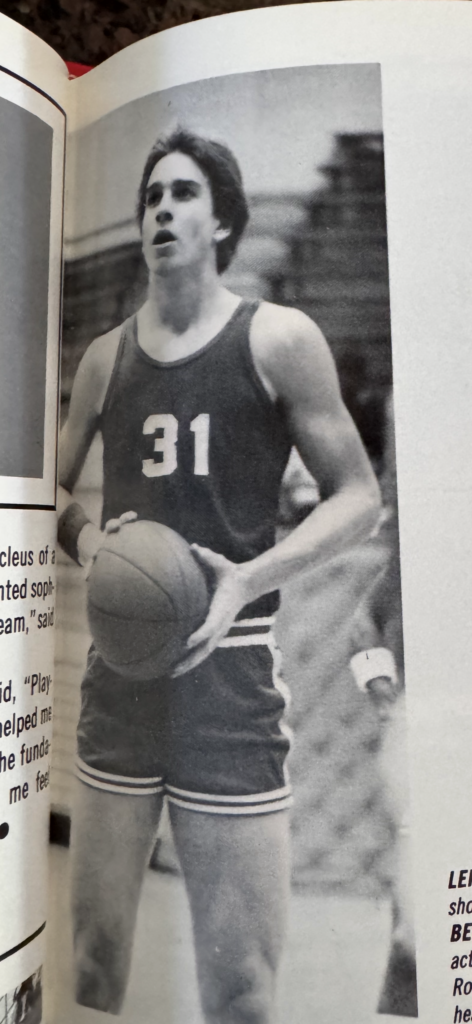
An old high school friend sent me this picture yesterday.
That’s me at 16.
Basketball in my hands. Hair still intact. Shorts way too tight. And short. Probably convinced I knew considerably more about life than I actually did.
My daughter is 16 now.
And that does something strange to your perspective.
Because when I look at this picture today, I don’t just see a younger version of myself. I see a kid the same age as my daughter, standing at the very beginning of a life he couldn’t possibly predict.
He has no idea what’s coming.
The careers. The mistakes. The wins. The losses. The people he’ll meet and the people he’ll lose. Starting a company. Riding fire engines. Becoming a father. Spending more than 30 years in recruiting. Watching an industry he loved begin to fundamentally change.
None of it is on his radar.
So if I could walk onto that basketball court, pull No. 31 aside, and get an hour with him, what would I say?
A lot, actually.
Although I’m pretty sure 16-year-old me wouldn’t listen to most of it.
I’d probably start here.
Pay attention to the signals.
You won’t understand what that means yet.
Someday, you will.
People will tell you what they think you want to hear. Companies will tell you everything is fine. Relationships will continue long after something important has changed. Leaders will defend strategies they privately stopped believing in months earlier.
And sometimes, you’ll do the same thing.
You’ll eventually learn that the truth usually whispers before it screams.
Listen earlier.
And when the same signal keeps showing up, stop explaining it away because you don’t like what it might mean.
One difficult conversation can be a bad day. One missed commitment can be a mistake. One disappointing quarter can be a setback.
But patterns deserve your attention.
Especially the patterns people keep asking you not to notice.
That lesson will become important enough that someday you’ll write an entire book about it.
But first, you’re going to have to learn it the hard way.
More than once.
Your career isn’t going to make much sense while you’re living it.
You’re going to work in HR. Staffing. Recruiting. Eventually media. You’ll build a talent-acquisition operation for a large television company. Then, one day, you’ll walk away from corporate America and start your own recruiting firm.
That last part is going to scare the hell out of you.
Do it anyway. It’s awesome…
You’ll spend decades listening to people explain why they’re unhappy, restless, afraid, or ready for something else.
Listen carefully.
Those conversations will teach you more about business than most spreadsheets ever could.
Eventually, you’ll notice something.
People usually leave emotionally before they leave physically.
By the time somebody resigns, the interesting part of the story happened months earlier.
That’s true of jobs.
It’s true of companies.
It’s true of industries.
And, kid, you’re eventually going to figure out it’s true of relationships too.
Don’t confuse stability with success.
There will be moments when staying feels safer.
A job. A company. A relationship. A version of yourself.
Sometimes staying will absolutely be the right decision. Not every hard season is a signal to leave. Some things are worth working through. Some people deserve the conversation. Some companies can still change direction.
But you need to learn the difference between discomfort and decline.
Discomfort asks you to grow.
Decline asks you to pretend.
Those are not the same thing.
Other times, staying is just fear wearing a respectable outfit.
Learn the difference.
And learn it faster than I did.
You’re capable of doing much harder things than you currently believe.
Someday, you’re going to run 13 marathons and two ultramarathons.
Right now, that probably sounds insane.
Good.
Some of the best things you’ll ever do will sound insane before you begin.
You don’t need to know how you’ll finish at the starting line.
Start.
Then figure out the next mile.
You’re also going to become a firefighter.
Didn’t see that one coming, did you?
You’ll spend 15+ years as a volunteer firefighter. You’ll become an EMT. Eventually, a lieutenant and a first-out engine officer.
Three times, you’ll come close enough to not making it home that “someday” will stop sounding like a promise.
You’ll ride an engine toward things everyone else is trying to get away from.
And somewhere along the way, the fire service will teach you something that applies to almost everything else in life.
Smoke matters before flames are visible.
Conditions matter before collapse.
Behavior matters before failure.
The best firefighters don’t wait for the roof to come down before acknowledging that the building is in trouble.
Neither should leaders.
Neither should companies.
Neither should you.
Don’t chase titles. Chase people who make you better.
A great boss can change the trajectory of your career.
A bad one can too.
You’re going to work for both.
Learn from both.
Pay attention to the leaders who make people want to run through walls for them. Pay even closer attention to the ones who make talented people quietly start looking for the exit.
The most dangerous leaders are not always the loudest ones.
Sometimes they’re the ones who slowly make good people smaller.
They stop asking for input.
They stop telling the truth.
They stop raising their hand.
By the time the resignation letter arrives, the real departure happened a long time ago.
Someday, you’ll be the person making hiring decisions and advising leaders about theirs.
Remember what it felt like to sit on the other side of the table.
Relationships compound just like money.
Return the phone call.
Answer the email.
Help people when there’s nothing in it for you.
Make the introduction.
Give somebody a chance.
Don’t keep score.
Decades later, you’ll realize that much of what people like to call a network is really just the accumulated result of how you treated people when you didn’t need anything from them.
Good people know good people.
Remember that.
Stop worrying so much about whether everybody likes you.
Some won’t.
You’ll survive.
One of the most expensive habits in life is making decisions primarily to avoid disappointing other people.
Be kind. Be fair. Be loyal.
But don’t outsource your life.
There is a difference between being a good person and allowing everyone else to vote on who you’re supposed to become.
Take more chances on experiences and fewer chances on bullshit.
Travel. Go to the concert. Take the trip. Buy the ticket. Get on the boat. Call the friend. Have the dinner.
There will always be another meeting. Another deadline. Another email sitting in an inbox pretending to be urgent.
There will not always be another summer.
Money matters. But freedom matters more.
Work hard. Make money. Save some. Spend some.
But understand what money is actually supposed to buy you.
Choices.
The ability to say yes when you want to say yes.
More importantly, the ability to say no when you need to say no.
The ability to walk away from a job, company, relationship, or situation that no longer fits your life is one of the most valuable forms of wealth you’ll ever have.
Not the car. Not the house. Not impressing people who aren’t thinking about you nearly as much as you imagine they are.
Freedom.
You’re going to screw some things up.
Professionally. Personally. Some spectacularly.
There will be decisions you wish you could reverse and conversations you’d give almost anything to redo.
You won’t get to.
Own them.
Apologize when you should.
Learn what there is to learn.
Then move.
Don’t build a permanent residence inside a temporary mistake.
That’s not accountability.
That’s just wasting more time.
And time, as you’re eventually going to discover, is the one thing you can’t earn back.
Which brings me to the part 16-year-old me could never really understand.
Someday, you’re going to have a daughter.
And somehow, that little girl is going to turn 16.
The same age you are in this picture.
That will mess with your head a little.
Because suddenly, you’ll look at this photograph differently.
You’ll stop seeing yourself as practically grown.
You’ll see a kid.
And you’ll realize your parents probably looked at you exactly the same way.
That’s when time starts looking different.
You’ll realize your parents weren’t old.
Your grandparents weren’t going to be there forever.
Neither are you.
And all those years you thought were moving slowly?
They weren’t.
Time doesn’t announce that it’s leaving.
It just leaves.
So be there.
Put the phone down.
Take the picture.
Stay another hour.
Ask the question.
Say the thing.
Tell people you love them while they’re sitting across the table instead of someday wishing you had.
And if 16-year-old me asked the obvious question—
“Does everything work out?”
I’d probably sit there for a second. Probably several.
Because the answer is no.
Not everything works out.
Some things break.
Some people leave.
Some dreams change.
Some doors close and never reopen.
There will be periods of your life when the plan gets completely blown up.
But here’s the part you can’t see yet.
Other doors will appear that you couldn’t possibly know existed at 16.
You’re going to build things you haven’t imagined yet.
You’re going to walk into burning buildings.
You’re going to cross finish lines you once thought were impossible.
You’re going to build a business. Maybe more than one.
You’re going to spend a career studying people, companies, and industries and eventually realize that the most important signals usually aren’t found in numbers.
They’re found in behavior.
You’re going to become a father.
And one day, your daughter will be 16.
Maybe that’s why, after thinking about all of this, I wouldn’t actually give that kid in the picture very many instructions.
I’d probably just tell him:
Pay attention.
Stay curious.
Take the chance.
Leave when the signals tell you it’s time.
Don’t waste years trying to force something that has already shown you what it is.
Choose good people.
Do hard things.
Collect experiences.
Call your parents.
Trust your gut more often.
And understand that the life you’re trying so desperately to figure out at 16 isn’t really something you figure out.
You build it.
One decision at a time.
One mistake at a time.
One signal at a time.
Most endings don’t arrive out of nowhere.
They announce themselves quietly first.
And then, right before I walked away, my 58-year-old self would probably ask one more question:
“Did you make the damn free throw?”
Now, ask yourself: What would you tell your 16-year-old self?
About Carver Talent
Carver Talent specializes in recruiting high-impact leaders across local television, digital media, revenue leadership, news management, and broadcast operations nationwide.
We understand this industry because we live in it every day.
And in a media landscape evolving this quickly, strategic talent decisions matter more than ever.

Ty Carver has over 30+ years of recruiting, HR management, sales, and leadership experience…including the last 15 specific to the broadcast media industry. He is the Founder/CEO of Carver Talent, a local broadcast media management recruiting firm. As the former Head of Recruiting for Raycom Media, he has deep industry relationships. Have a media corporate executive/management or television station management recruiting need? Contact ty@carvertalent.com for more information.